
Do two pale-green goblets belong in one pattern lot because they look alike, or should different rims, feet, and marks give each glass a separate lot number? Accurate estate sale preparation starts by preserving those differences before a familiar-looking motif becomes an unsupported attribution.
What should be recorded before vintage glassware pattern identification begins?
Vintage glassware should be inventoried piece by piece before maker or pattern names are assigned, because shared color or decoration does not prove that two glasses belong in the same auction lot.
A numbered glassware inventory preserves each object’s catalogue identity
- Assign a temporary number. Use a structure such as Tray 01, Box 02, Item 03, written as T01-B02-I03. Number stoppers, lids, underplates, and inserts as components of the principal item.
- Record the physical data. Enter quantity, object form, height, maximum diameter, rim diameter, base diameter, and weight when weight helps distinguish similar forms. Follow the auction house’s convention for inches, centimeters, or both.
- Describe what is present. Record color, applied or cut decoration, visible marks, component count, and condition. Use “pair” only when dimensions, color, decoration, and construction agree. Classify other similar examples as nonmatching duplicates.
- Protect the evidence. Do not stack glass without padding. Support stems, remove loose stoppers for transport, and avoid rubbing enamel, flashing, gilding, or painted decoration. Keep adhesive labels off decorated, iridescent, painted, or unstable surfaces. Place the number on an archival tag tied loosely or stored beside the object.
| Temporary number | Inventory entry |
|---|---|
| T01-B02-I03 | Quantity 1; goblet; H 6 1/8 in.; maximum diameter 3 1/4 in.; rim 2 7/8 in.; base 2 5/8 in.; 188 g; pale green; wheel-cut leaf motif; no visible mark; one component; rim flea bite and base wear; photographs 003A–003F. |
Neutral photographs distinguish glass color, form, and pattern details
Working photographs should show the full profile, base, maker mark, rim, pattern close-up, and every defect. Include the temporary number and a scale in at least one frame. Use diffuse, neutral lighting and a plain white or gray background, principles consistent with the National Park Service Museum Handbook’s documentation guidance.
Automatic white balance, transmitted light, and colored backgrounds can shift apparent color, so camera color remains a clue rather than a catalogue fact. Photograph clear and colored glass against light and dark neutral grounds when edges or decoration disappear. Once identity, dimensions, components, and images remain attached to each object, the maker or pattern can be tested without relying on appearance alone.
How is a vintage glassware maker or pattern identified without relying on appearance alone?
A vintage glassware attribution is strongest when marks, form, dimensions, color, and pattern details agree with dated manufacturer literature or a museum record. Image resemblance alone supports only a tentative description; conflicting measurements, marks, or production methods require qualified or unidentified catalogue language.
Manufacturer catalogues and museum records outrank visual pattern matches
| Confidence | Evidence required | Catalogue treatment |
|---|---|---|
| Documented | Dated manufacturer page or museum record matching maker, exact form, dimensions, pattern, and color | State maker and pattern without qualification |
| Attributed | Strong physical match corroborated by a scholarly reference or independent record | Use “attributed to” |
| Possibly | Commercial database, dealer listing, or partial visual match without independent confirmation | Use “possibly” or “in the manner of” as applicable |
| Unidentified | Unsourced image match, contradictory evidence, or no reliable documentation | Describe form, color, decoration, and condition only |
Manufacturer catalogues should show the pattern name or number, object form, measurements, available colors, and publication date. Museum records should supply an accession number, maker, date range, material, measurements, and curatorial attribution. A specialist book requires author, title, edition, publication year, and a cited page or plate. The Rakow Research Library collections illustrate the archival value of company records, drawings, correspondence, and production material, but the collection summary does not identify a particular tableware pattern.
Maker marks identify vintage glassware only within documented production contexts
An acid-etched signature, molded mark, paper label, or engraved numeral may identify a manufacturer without identifying the pattern, date, factory, or production line. Pattern names can cover several forms, sizes, colors, and production periods. Compare the exact form and dimensions, not merely the motif.
Mark chronologies must account for ownership changes, factories, export markets, and production methods. Paper labels can migrate, signatures can be copied, and successor companies can reuse molds. Polished pontils, mold seams, pressed details, wheel cutting, and applied decoration help distinguish originals, later reissues, reproductions, and look-alike patterns. This is also how documented labels affect estate-auction lot construction.
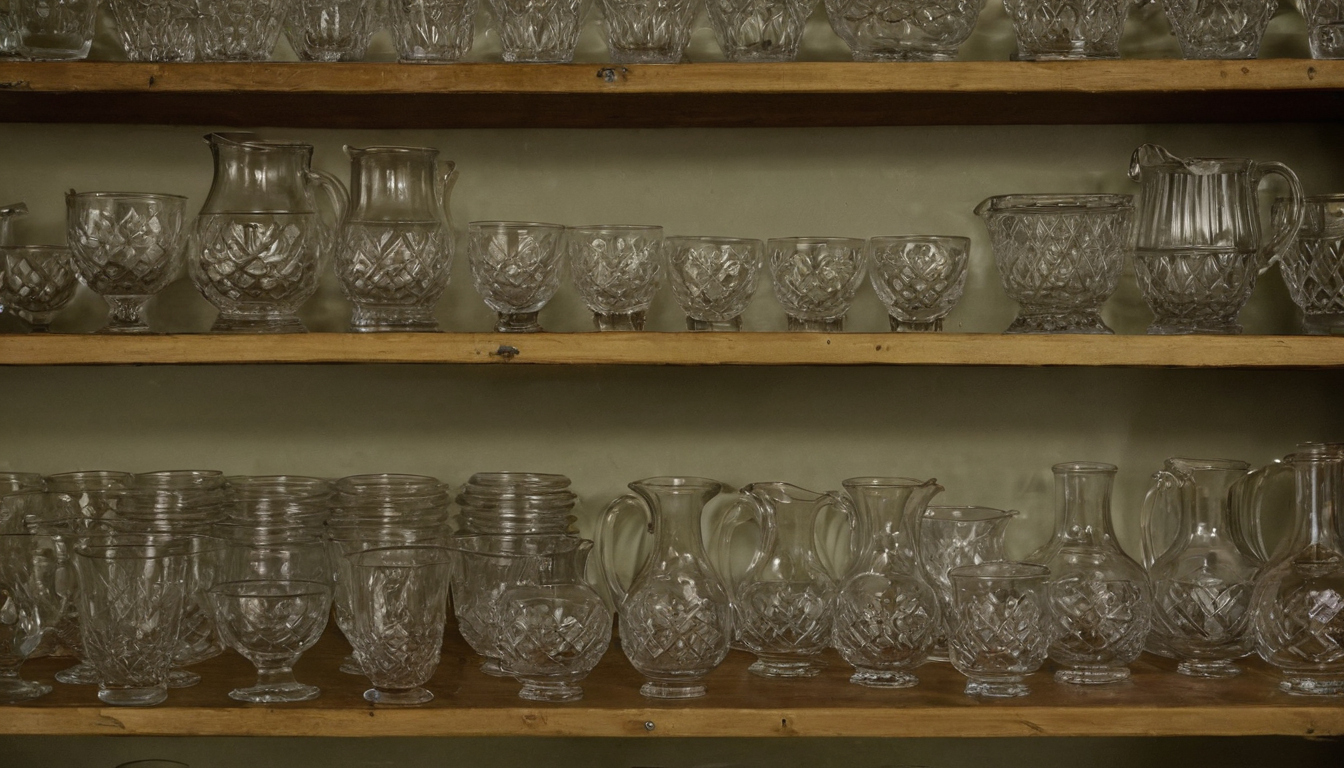
How is a vintage glassware maker or pattern identified without relying on appearance alone shown as an editorial planning reference.
Ultraviolet response and production clues are supporting evidence, not standalone attribution
Ultraviolet fluorescence cannot by itself prove age, maker, or composition. Lamp wavelength, ambient light, coatings, repairs, and contamination can alter the observation. Record the test conditions and treat the result as supporting evidence. The National Park Service Museum Handbook supplies broader preservation and documentation guidance for object examination.
Once an evidence grade is assigned, exact measurements, documented colors, and missing components determine whether the apparent match survives cataloguing.
Which measurements, colors, and missing components separate one vintage glassware pattern from another?
Vintage glassware measurements and component counts must be compared with documented examples of the same form, not a generic pattern image. Differences in height, rim profile, foot, stopper, handle, or color may indicate another production issue, a replacement component, or an incomplete set requiring separate catalogue treatment.
Glassware dimensions must use repeatable measurement points
| Form | Record |
|---|---|
| Tumbler or goblet | Height, rim diameter, maximum diameter, foot diameter, and capacity |
| Decanter or lidded form | Body height, total height, maximum diameter, rim opening, and stopper or lid dimensions |
| Bowl, plate, or compote | Maximum diameter, rim diameter if different, height, and foot diameter |
| Vase, pitcher, or handled form | Height, rim diameter, maximum body diameter, base diameter, and maximum width across handles or spout |
Measure irregular rims at the highest and lowest points. Include applied feet and handles in maximum dimensions. Measure stopper length separately, including the ground shank, and state whether total height includes the stopper. Record capacity as brimful or practical capacity, never simply “capacity.” Apply the auction house’s rounding convention consistently.
Record a documented manufacturer color name in quotation marks when available, followed by a plain description such as pale amber. Note batch variation, fading, staining, flashed color, iridescence, and camera-rendering differences rather than treating every shade as a separate colorway.
A complete vintage glassware set requires documented original components
Call a set complete only when a manufacturer catalogue or museum record confirms its component count. Check stoppers, lids, underplates, inserts, stands, spoons, cords, labels, and fitted cases for fit, color, wear, and matching decoration.
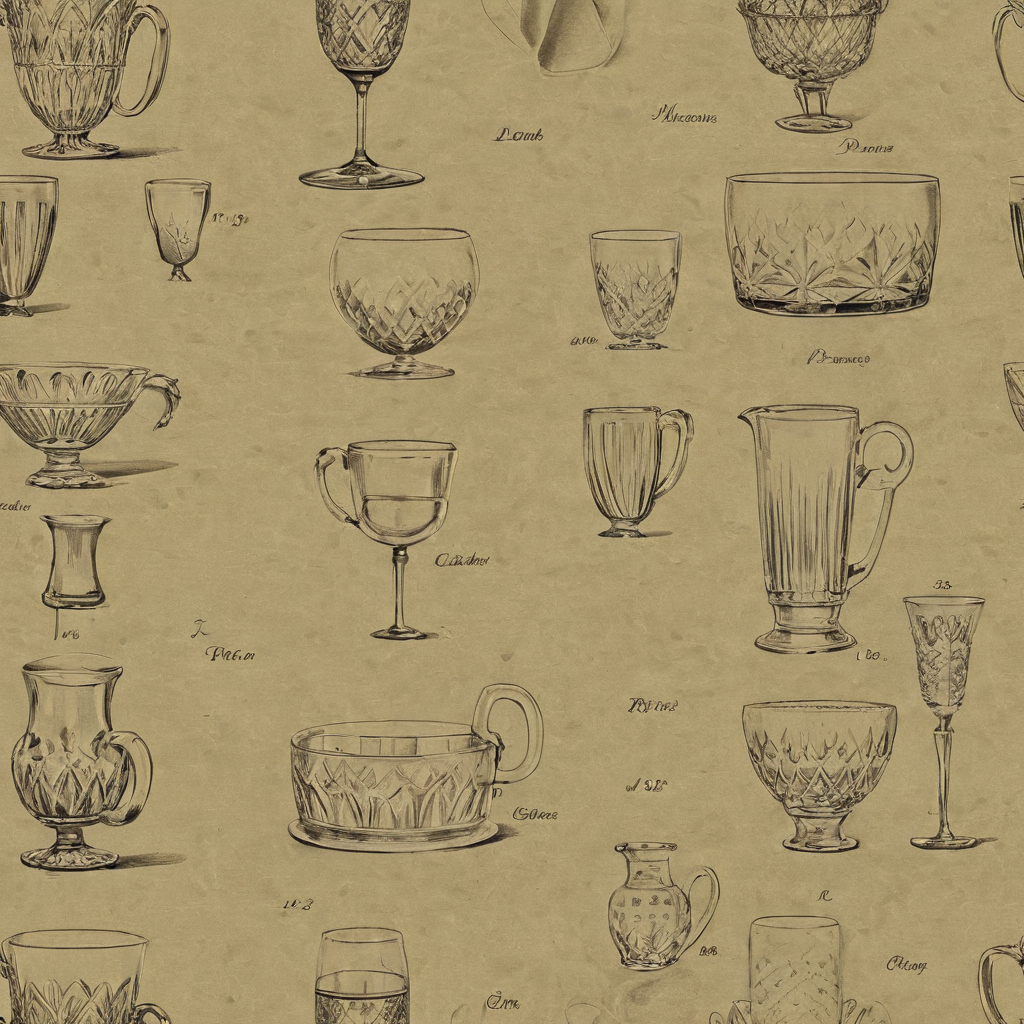
Which measurements, colors, and missing components separate one vintage glassware pattern from another shown as an editorial planning reference.
Use pair for two corresponding objects, suite or service for documented coordinated forms, assembled set for later combinations, married for a mismatched lid or stopper, and group when no original relationship is established. Once completeness is settled, condition requires equally exact catalogue language.
How should chips, flea bites, clouding, staining, and polishing be catalogued on vintage glassware?
Vintage glassware condition should record each defect’s type, location, extent, and visibility, because rim damage, cracks, clouding, staining, polishing, scratches, and decoration loss may require an otherwise matching piece to receive a separate lot number.
Condition nouns make vintage glassware reports more useful than general grades
- Inspect clean, dry glass under diffuse and raking light. Rotate each piece over a padded surface. Use magnification for rim nicks, short cracks, repairs, and decoration edges.
- Name the defect. A chip removes glass; a flea bite is a minute edge nick; a bruise is a localized impact fracture beneath or around the surface; a crack is a linear fracture. Record the location and approximate extent.
- Describe clarity precisely. Separate loose residue from mineral staining, internal clouding, surface scratching, and dishwasher etching. “Sick glass” is sometimes used for persistent deterioration or cloudiness, but the catalogue should describe the visible condition instead of relying on that variable trade term.
- Record decoration loss by material. Use gilt loss, enamel loss, flaking, fading, rubbing, or later overpainting. Do not scrub, soak, or polish areas where treatment could remove paper labels, gilding, enamel, iridescence, or evidence of age.
Model entries include: “One shallow rim chip, visible in profile, with two adjacent flea bites.” “Persistent internal clouding across the lower bowl; not removed by gentle surface wiping.” “Scattered gilt rubbing at the rim and approximately one-third loss to the central enamel motif.”
How should chips, flea bites, clouding, staining, and polishing be catalogued on vintage glassware shown with practical context cues.
Observed facts belong in the report. An uncertain repair requires qualified language: “Possible polished chip at rim; cause not established by visual inspection.” Condition reports are opinions rather than substitutes for examination, so the selected auction platform’s current disclaimer and inspection terms should be checked before cataloguing.
Manufacturing irregularities must be separated from later glass damage
- Production evidence: Bubbles, inclusions, mold seams, tool marks, annealing lines, and rough pontils may arise during manufacture. Record them as manufacturing irregularities when the physical evidence supports that conclusion.
- Later alteration: Fresh grinding, an uneven rim, changed proportions, matte abrasion, or an unusually smooth depression may indicate rim reduction, a polished chip, or repair.
- Unresolved cause: Use “irregularity,” describe its position and appearance, and avoid declaring either manufacture or damage without sufficient evidence.
A materially damaged piece should leave a pattern group when its crack, repair, rim reduction, persistent clouding, or substantial decoration loss makes the group condition materially inconsistent. Sold records must then be checked for the same pattern, quantity, and condition.
Which sold lots are valid comparables for identified vintage glassware?
Valid vintage glassware comparables match the attributed maker, pattern, form, size, color, component count, condition, and sale basis as closely as the archive permits. Each record must confirm the sale date, currency, sold status, and whether the published result is a hammer price or a buyer-inclusive figure.
| Comparable file | Minimum record | Matching priority |
|---|---|---|
| Identified pattern | At least three verified sold lots | Maker and pattern, form, period, dimensions, color, completeness, condition, lot size |
| Mixed or unidentified lot | At least two verified sold lots | Piece count, condition mix, venue, photographs, shipping restrictions, sale date |
Hammer price and buyer-inclusive price are different auction data fields
Record the auction house, sale title, date, lot number, description, quantity, dimensions, color, condition, estimate, hammer price, buyer-inclusive result if supplied, currency, and sold or passed status. Check that auction house’s terms for premium and tax treatment. Compare hammer with hammer and label inclusive results separately. For currency conversion, retain the exchange-rate source and conversion date.
Mixed glassware lots require mixed-lot comparables
Exclude asking prices, result-free listings, relisted lots, duplicate syndicated records, and figures with unclear premium treatment. A single identified goblet does not compare with a tray of unrelated, damaged pieces. Local pickup, third-party shipping, venue, and photography can also limit comparison. A clean evidence set supports the final choice among an individual object, verified pattern group, or mixed lot.
Should vintage glassware be catalogued individually, by pattern, or in mixed lots?
Vintage glassware warrants an individual lot when attribution, completeness, condition, and close sold records support object-specific data. Matching pieces may form a pattern lot when evidence and condition agree. Unresolved, incomplete, unrelated, or heavily damaged pieces may enter a mixed lot, subject to current house and shipping policies.
A three-way decision matrix assigns the vintage glassware lot structure
| Test | Individual | Pattern group | Mixed lot |
|---|---|---|---|
| Attribution | Defensible; distinct form | Same documented pattern | Unresolved or unrelated |
| Components | Complete | Compatible form, color, dimensions | Incomplete |
| Condition | Fully disclosed | Reasonably consistent | Variable or damaged |
| Comparables | Close sold records | Matching-set records | Mixed-lot records |
| Risk and policy | Shipping practical | Packing practical | Review labor and breakage risk |
Specialist review is due when disputed attribution would change catalogue accuracy. Before consignment, verify seller commission, catalogue or photography fees, reserve and withdrawal rules, buyer’s premium, minimums, unsold-lot terms, packing charges, pickup requirements, carrier restrictions, and in-house shipping exclusions. Never merge pieces merely to reach a predicted price point.
Qualified catalogue language prevents unsupported glassware attribution
House definitions control. “Attributed to” generally indicates a probable maker; “manner of” or “style of” describes influence; “possibly” records unresolved evidence; “unidentified” makes no maker claim. Suitable titles include “Attributed to [Maker], [Pattern] Vase,” “[Maker], [Pattern], Group of Six Goblets,” and “Mixed Lot of Unidentified Colored Glassware.”
Record maker, pattern, period, form, material, color, dimensions, quantity, marks, provenance source, condition, and qualifier. Let documented evidence, not resemblance, determine the final lot.
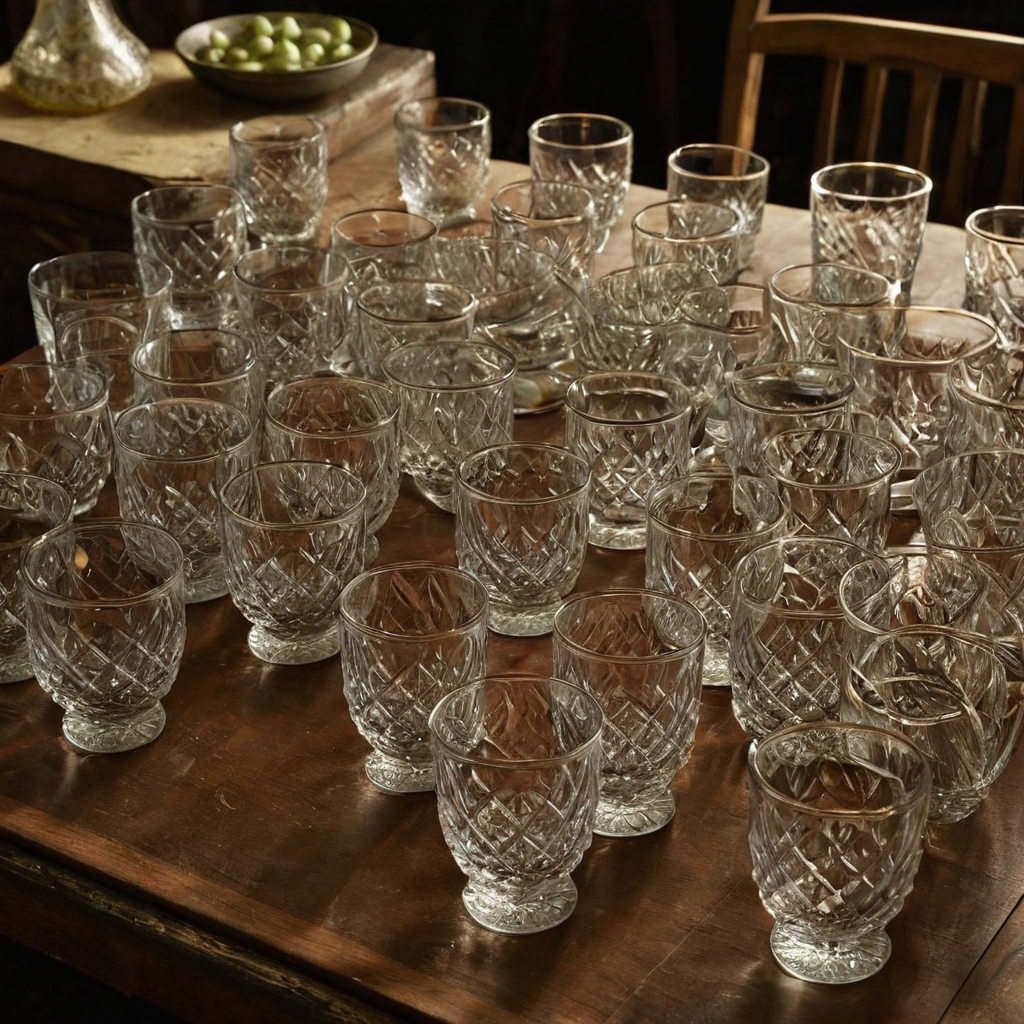
Should vintage glassware be catalogued individually, by pattern, or in mixed lots shown with practical context cues.
Frequently asked questions
How can an inherited vintage glass pattern be identified when no maker mark is present?
Compare the exact form, dimensions, color, decoration, construction, and component count with dated manufacturer literature and museum records. Without corroboration, describe the object and keep the maker unidentified.